Before you open a single book, you need to know exactly what SSC CGL Tier 1 asks for. This guide breaks the paper down section by section and highlights the topics that carry the most weight.
Note: patterns can change between notifications. Always cross-check with the official SSC notice for your exam year.
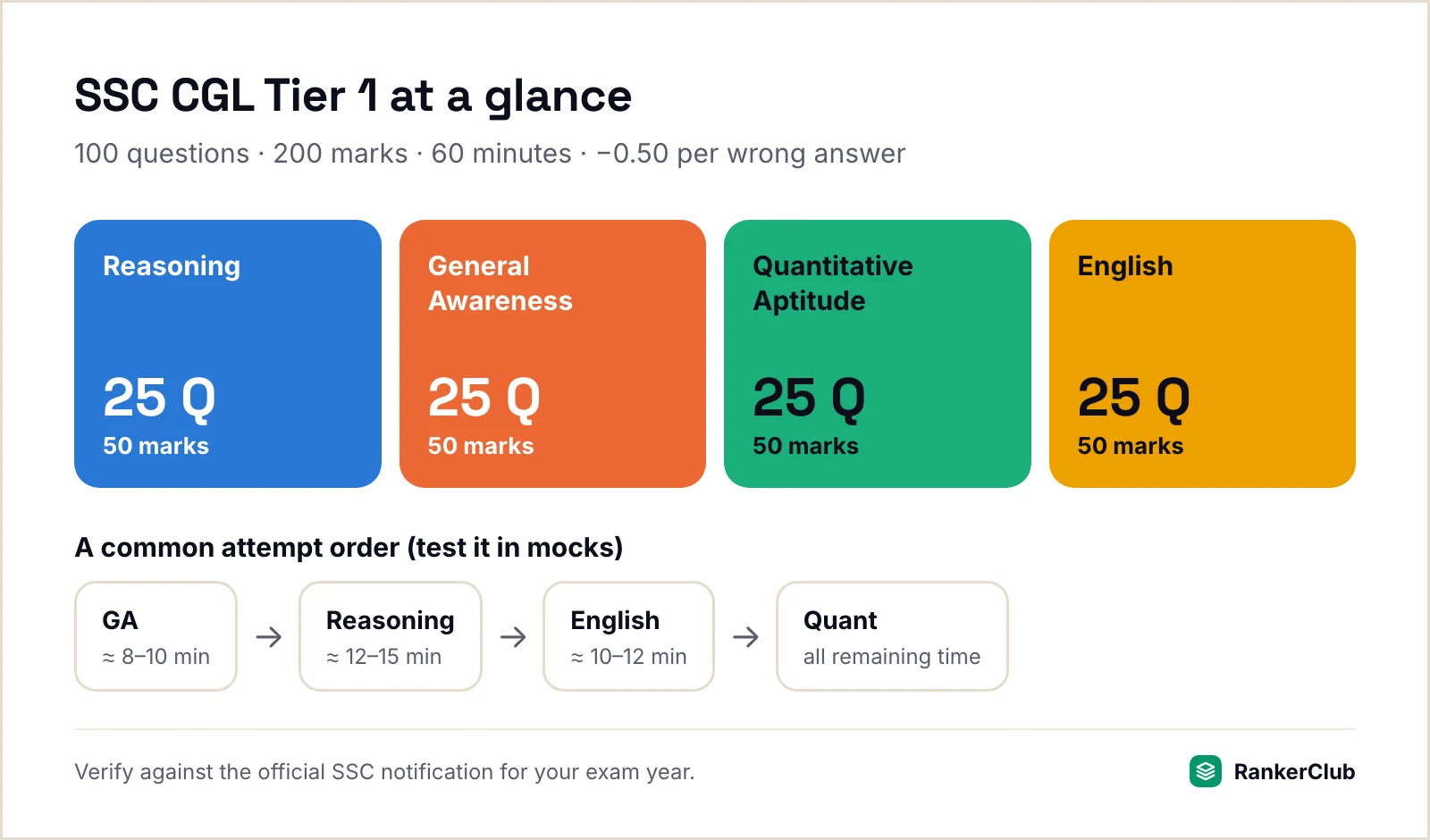
Tier 1 at a glance
- Mode: Computer-based test (CBT)
- Duration: 60 minutes
- Questions: 100 multiple-choice questions
- Total marks: 200 (2 marks per question)
- Negative marking: 0.50 marks deducted per wrong answer
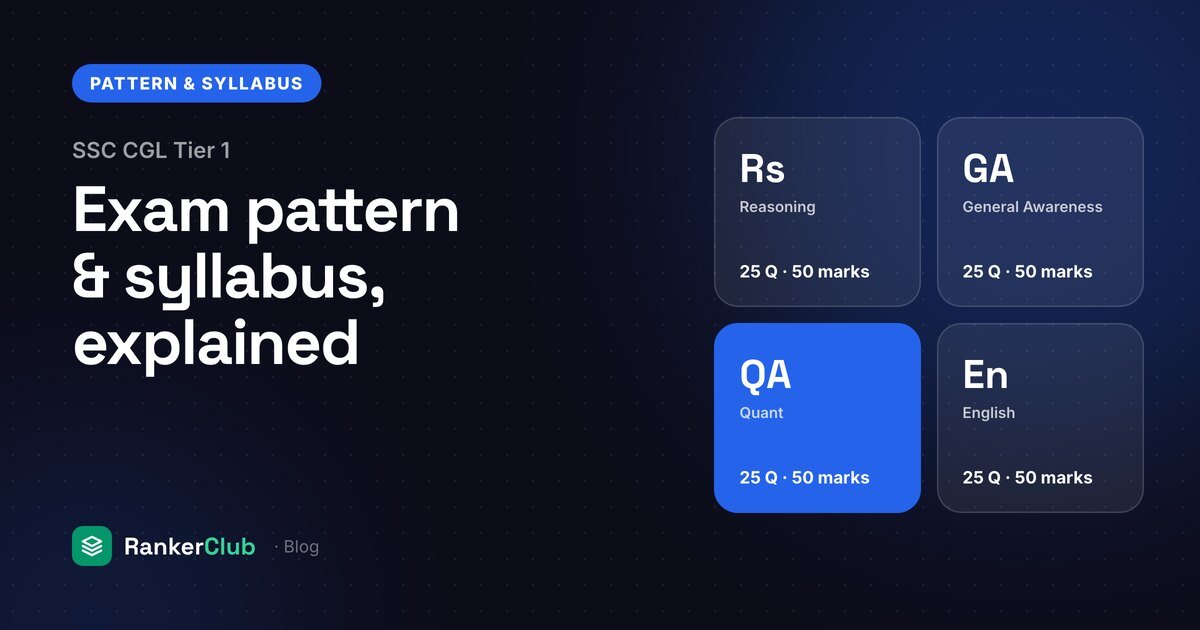
- Sections: 4, each with 25 questions and 50 marks
Tier 1 is a qualifying-and-screening stage: it decides who moves on to Tier 2, which carries the main weight in the final merit.
1. General Intelligence & Reasoning
Usually the highest-scoring section for well-prepared candidates.
High-frequency topics
- Analogy and classification (odd one out)
- Number and letter series
- Coding-decoding
- Blood relations and direction sense
- Syllogism and Venn diagrams
- Non-verbal: mirror images, paper folding, embedded figures, counting figures
Tip: Non-verbal questions are quick marks once you have practised 200–300 of them. Don't skip them.
2. General Awareness
The most unpredictable section, but also the fastest — you either know the answer or you don't.
- Static GK: history, polity, geography, economics
- General science: physics, chemistry, biology at roughly class 10 level
- Current affairs: roughly the last 6–8 months before the exam
Tip: Spend no more than 8–10 minutes here in the exam. Use the saved time on Quant.
3. Quantitative Aptitude
The section that most often decides the cut-off.
Arithmetic
- Percentage, profit & loss, discount
- Ratio & proportion, average, mixtures
- Simple and compound interest
- Time & work, time-speed-distance
Advanced maths
- Algebra and identities
- Geometry (triangles, circles)
- Trigonometry and heights & distances
- Mensuration (2D and 3D)
- Data interpretation (bar, pie and line charts)
4. English Comprehension
- Spotting errors and sentence improvement
- Synonyms, antonyms, idioms and one-word substitution
- Active-passive and direct-indirect speech
- Cloze test and reading comprehension
- Spelling correction
Tip: Vocabulary questions are pure memory. Fifteen words a day for six months is over 2,700 words — more than enough.
How to plan your attempt
With 60 minutes for 100 questions, a common order is GA → Reasoning → English → Quant: finish the fast sections first, then give Quant all the remaining time. Try two or three different orders in mocks and keep whichever gives you the best score.
Want to see the pattern in action? Take a free SSC CGL Tier 1 mock in the exact exam format.
Frequently asked questions
How many questions are there in SSC CGL Tier 1?
Tier 1 has 100 questions — 25 each from Reasoning, General Awareness, Quantitative Aptitude and English — for a total of 200 marks in 60 minutes.
What is the negative marking in SSC CGL Tier 1?
0.50 marks are deducted for every wrong answer. Unattempted questions carry no penalty.
Is Tier 1 counted in the final SSC CGL merit?
Tier 1 is used for screening candidates for Tier 2; the final merit is mainly based on Tier 2. Check the official notification for your exam year, as SSC revises the scheme from time to time.