🎯 RankerClub is 100% Free — 97 full-length mock tests with an instant all-India rank. Register Free →
RankerClub
SSC
Category

SSC Exams 2026: Free Mock Tests

Staff Selection Commission exams

6

Exams

294

Tests

SSC exam guide

SSC Exams: How They Work, Pattern, Subjects & Preparation

The Staff Selection Commission (SSC) recruits staff for Group B and Group C posts in central government ministries, departments and organisations — from Assistant Section Officers and Income Tax Inspectors to clerks, multi-tasking staff and constables in the armed police forces.

Every SSC exam follows the same basic idea: a computer-based test screens candidates, further tiers or physical tests narrow the list, and the final merit decides who gets which post and department. If you understand one SSC exam well, the others feel very familiar.

Conducted byStaff Selection Commission
ModeComputer-based test (CBT)
FrequencyMost exams once a year
Eligibility10th, 12th or graduation, by exam

How it works

How SSC selection works, step by step

Notification

SSC publishes an annual exam calendar, then a detailed notice for each exam with vacancies, eligibility, age limits and dates.

Online application

Register once on the SSC portal, then apply for each exam and pay the fee (women, SC/ST, PwBD and ex-servicemen are usually exempt).

Tier 1 CBT

An objective, computer-based screening test. Candidates are shortlisted for the next stage based on category-wise cut-offs.

Tier 2 / physical tests

Depending on the exam: a deeper CBT (CGL, CHSL), a typing or skill test, or physical efficiency and standard tests (GD, CPO, MTS Havaldar).

Document verification

Shortlisted candidates verify certificates, category and eligibility. Some exams also include a medical examination.

Final merit & allocation

Posts and departments are allotted using your final score and the preferences you submitted.

Exam pattern

Exam pattern: sections, questions, marks & time

Combined Graduate Level — the flagship SSC exam for graduates. Posts include Assistant Section Officer, Income Tax Inspector, Excise Inspector, Auditor and Accountant.

Tier 1 (qualifying / screening)

General Intelligence & Reasoning 25% General Awareness 25% Quantitative Aptitude 25% English Comprehension 25%
SectionQuestionsMarks
General Intelligence & Reasoning 25 50
General Awareness 25 50
Quantitative Aptitude 25 50
English Comprehension 25 50
Total · 60 min 100 200

−0.50 for each wrong answer.

Tier 2 — Paper I (compulsory for all posts)

Mathematical Abilities 23% Reasoning & General Intelligence 23% English Language & Comprehension 35% General Awareness 19%
SectionQuestionsMarks
Mathematical Abilities 30 90
Reasoning & General Intelligence 30 90
English Language & Comprehension 45 135
General Awareness 25 75
Computer Knowledge (qualifying) 20 60
Data Entry Speed Test (qualifying) 1 task —
Total · 2 hr 30 min (in sessions) — 390

−1 for each wrong answer in Sections I and II. Paper II (Statistics) and Paper III (General Studies – Finance & Economics) are only for JSO and AAO posts.

Combined Higher Secondary Level — for 12th-pass candidates. Posts: Lower Division Clerk, Junior Secretariat Assistant and Data Entry Operator.

Tier 1

English Language 25% General Intelligence 25% Quantitative Aptitude (basic arithmetic) 25% General Awareness 25%
SectionQuestionsMarks
English Language 25 50
General Intelligence 25 50
Quantitative Aptitude (basic arithmetic) 25 50
General Awareness 25 50
Total · 60 min 100 200

−0.50 for each wrong answer.

Tier 2 has two objective sections (Maths + Reasoning; English + General Awareness), a qualifying computer module, and a skill/typing test.

SSC MTS & Havaldar

Free mock tests →

Multi-Tasking (Non-Technical) Staff and Havaldar in CBIC/CBN — for 10th-pass candidates.

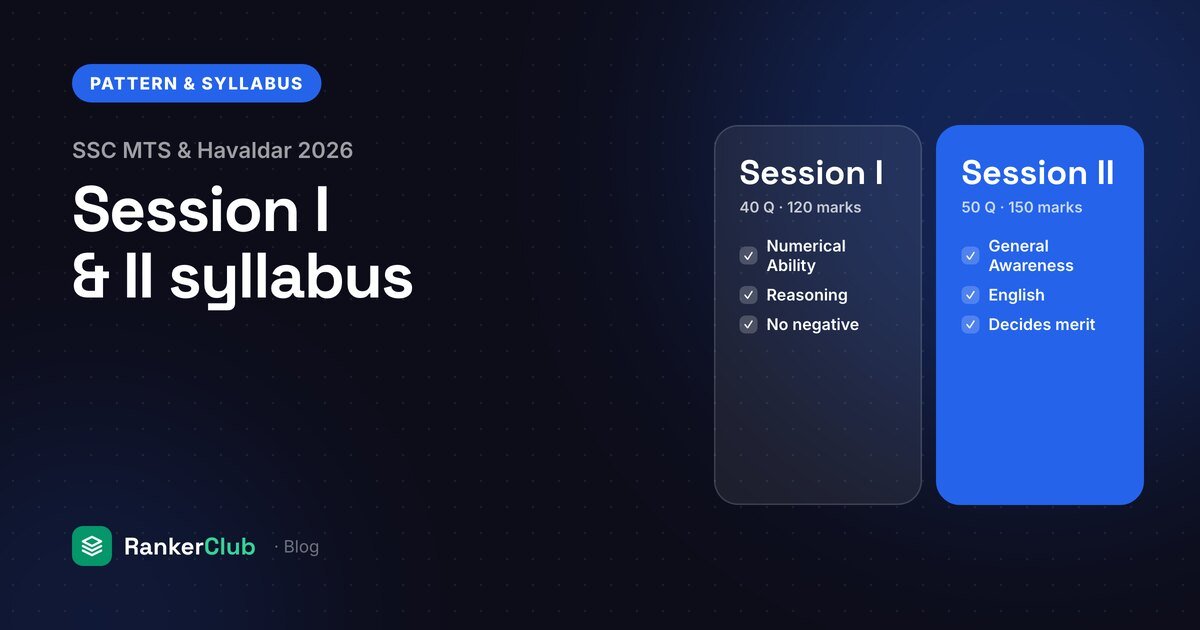
Computer-based exam (two sessions, 45 min each)

Session I: Numerical & Mathematical Ability 22% Session I: Reasoning Ability & Problem Solving 22% Session II: General Awareness 28% Session II: English Language & Comprehension 28%
SectionQuestionsMarks
Session I: Numerical & Mathematical Ability 20 60
Session I: Reasoning Ability & Problem Solving 20 60
Session II: General Awareness 25 75
Session II: English Language & Comprehension 25 75
Total · 90 min 90 270

No negative marking in Session I; −1 per wrong answer in Session II. Havaldar candidates also take a physical efficiency and standard test.

SSC GD Constable

Free mock tests →

Constable (General Duty) in BSF, CISF, CRPF, ITBP, SSB, SSF, Assam Rifles and NCB — for 10th-pass candidates.

Computer-based exam

General Intelligence & Reasoning 25% General Knowledge & General Awareness 25% Elementary Mathematics 25% English / Hindi 25%
SectionQuestionsMarks
General Intelligence & Reasoning 20 40
General Knowledge & General Awareness 20 40
Elementary Mathematics 20 40
English / Hindi 20 40
Total · 60 min 80 160

−0.25 for each wrong answer. Followed by PET/PST (running, height, chest), medical examination and document verification.

Syllabus

Subjects and important topics

Quantitative Aptitude

Number systemPercentageRatio & proportionProfit & lossSimple & compound interestTime & workTime, speed & distanceAlgebraGeometryTrigonometryMensurationData interpretation

Reasoning

Analogy & classificationSeriesCoding-decodingBlood relationsDirection senseSyllogismVenn diagramsSeating arrangementMirror & water imagesPaper foldingEmbedded figures

English

Error spottingSentence improvementFill in the blanksSynonyms & antonymsIdioms & phrasesOne-word substitutionActive-passiveDirect-indirect speechCloze testReading comprehension

General Awareness

Indian historyPolity & constitutionGeographyEconomicsGeneral scienceStatic GKCurrent affairs (last 6–8 months)

Strategy

How to prepare for SSC exams

01Start with the common core

Quant, Reasoning, English and GA cover every SSC exam. Build them once and you can take CGL, CHSL and MTS in the same year.

02Use previous years' papers

SSC repeats question types heavily. Solve at least the last three years of papers for your exam before buying any new book.

03Speed is the real test

Tier 1 gives you about 36 seconds per question. Learn calculation shortcuts and practise with a timer from week one.

04Mock, then analyse

Take a full mock every week in the first half of your prep and two to three a week near the exam. Spend as long analysing as you did writing.

05Don't ignore physical tests

For GD, CPO and Havaldar, start running practice months before the written result — PET failures are common and avoidable.

From the blog

Read next

FAQs

Frequently asked questions about SSC exams

How many SSC exams are there in a year?

SSC conducts around ten major exams every year, including CGL, CHSL, MTS, GD Constable, CPO, Stenographer, JE and Selection Posts. The yearly calendar on ssc.gov.in lists the tentative dates.

Is there negative marking in SSC exams?

Yes. Most SSC computer-based tests deduct marks for wrong answers — for example 0.50 marks per question in CGL and CHSL Tier 1 and 0.25 marks in GD Constable. MTS Session I has no negative marking.

What is the age limit for SSC exams?

It depends on the post: typically 18–27 years for most CGL and CHSL posts and 18–23 for GD Constable, with up to 32 years for some CGL posts. Reserved categories get age relaxation as per government rules.

Can I apply for SSC CGL in the final year of graduation?

Usually yes, provided you complete your degree by the cut-off date mentioned in the notification. Check the exact date in that year's notice.

Is the same syllabus enough for CGL and CHSL?

Largely yes. The four subjects are the same; CGL Tier 2 goes deeper in Maths and English, while CHSL adds a typing or skill test.

Exam patterns, marks and eligibility are based on the latest notifications available and can change from one cycle to the next. Always confirm the details in the official notification on ssc.gov.in before you apply.

Practise for SSC exams

Free full-length mock tests with an instant all-India rank.

Choose your exam →