🎯 RankerClub is 100% Free β€” 97 full-length mock tests with an instant all-India rank. Register Free β†’
RankerClub
BANK
Category

Banking Exams 2026: Free Mock Tests

IBPS, SBI and RBI banking exams

7

Exams

247

Tests

Banking exam guide

Banking Exams: How They Work, Pattern, Subjects & Preparation

Banking exams recruit Probationary Officers (POs), clerks and specialist officers for public-sector banks, regional rural banks, the State Bank of India and regulators like the Reserve Bank of India and NABARD.

Most bank exams share a three-step structure: a short, speed-based Prelims, a tougher Mains with banking and economy awareness, and β€” for officer posts β€” an interview. Prelims tests speed; Mains tests depth and accuracy.

Conducted byIBPS, SBI, RBI, NABARD
ModeOnline CBT + interview (officers)
FrequencyOnce a year per exam
EligibilityGraduation in any discipline

How it works

How Banking selection works, step by step

Notification

IBPS releases its yearly calendar; SBI, RBI and NABARD publish their own notices on their career pages.

Prelims

A 60-minute objective test with separate timers for each section. It is qualifying β€” marks are not counted in the final merit.

Mains

A longer objective test plus, for PO exams, a descriptive English paper (letter and essay). Mains marks count towards the final merit.

Interview / psychometric

Officer posts have an interview (and SBI adds a psychometric test and group exercise). Clerk posts have no interview.

Final merit & allotment

For IBPS PO, Mains and interview marks are combined 80:20. IBPS then allots candidates to participating banks by merit and preference.

Exam pattern

Exam pattern: sections, questions, marks & time

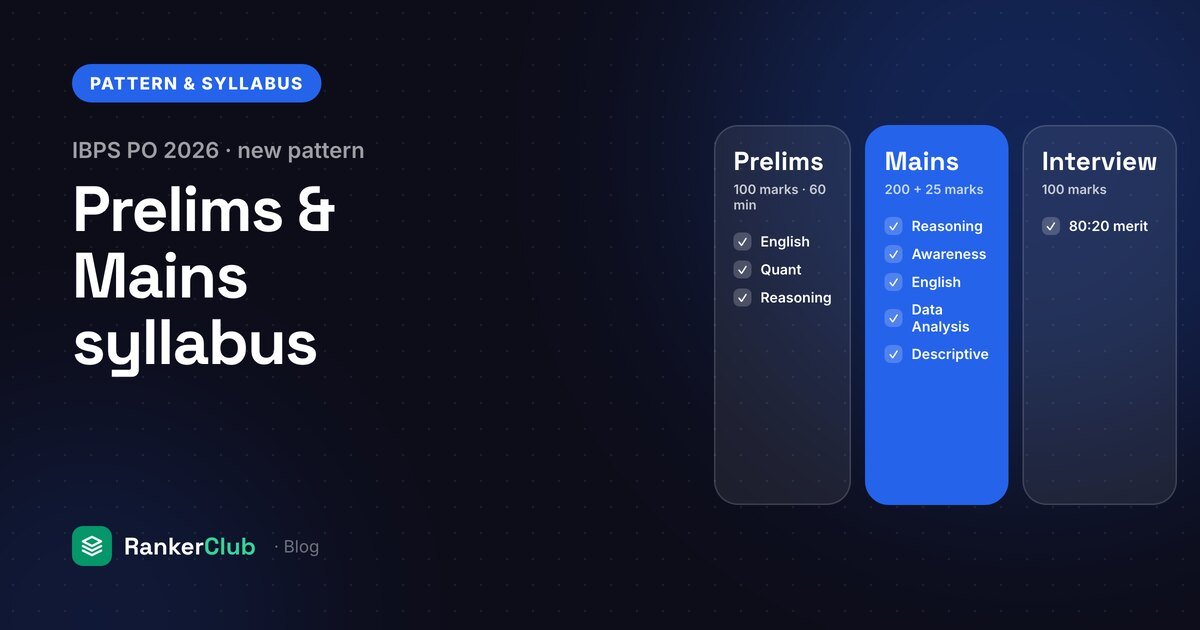
Probationary Officer / Management Trainee in public-sector banks such as Bank of Baroda, PNB, Canara Bank and others.

Prelims (qualifying)

English Language 30% Quantitative Aptitude 35% Reasoning Ability 35%
SectionQuestionsMarks Time
English Language 30 30 20 min
Quantitative Aptitude 35 35 20 min
Reasoning Ability 35 35 20 min
Total 100 100 60 min

βˆ’0.25 of the question's marks for each wrong answer. Each section has its own cut-off.

Mains

Reasoning & Computer Aptitude 27% General / Economy / Banking Awareness 18% English Language 18% Data Analysis & Interpretation 27% English Descriptive (letter + essay) 11%
SectionQuestionsMarks Time
Reasoning & Computer Aptitude 45 60 60 min
General / Economy / Banking Awareness 40 40 35 min
English Language 35 40 40 min
Data Analysis & Interpretation 35 60 45 min
English Descriptive (letter + essay) 2 25 30 min
Total 157 225 3 hr 30 min

Interview: 100 marks. Final merit = Mains and interview in an 80:20 ratio.
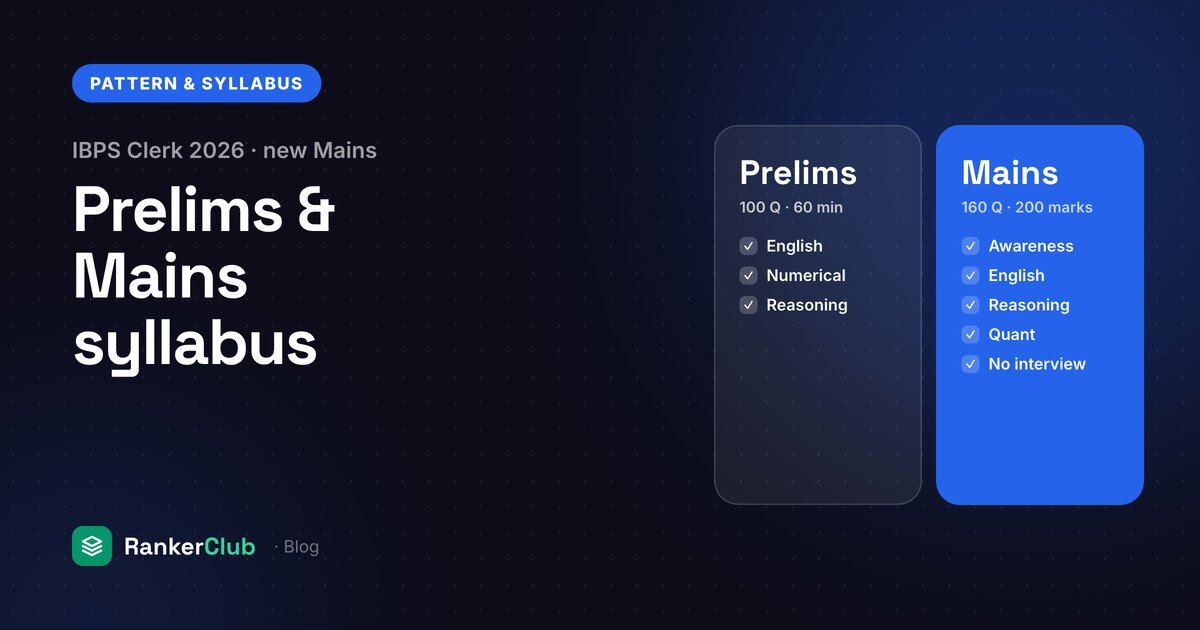
Clerical cadre (Customer Service Associate) in public-sector banks. Selection is state-wise, so knowing the local language is required.

Prelims (qualifying)

English Language 30% Numerical Ability 35% Reasoning Ability 35%
SectionQuestionsMarks Time
English Language 30 30 20 min
Numerical Ability 35 35 20 min
Reasoning Ability 35 35 20 min
Total 100 100 60 min

βˆ’0.25 of the question's marks for each wrong answer.

Mains (final merit)

General / Financial Awareness 25% General English 20% Reasoning & Computer Aptitude 30% Quantitative Aptitude 25%
SectionQuestionsMarks Time
General / Financial Awareness 50 50 35 min
General English 40 40 35 min
Reasoning & Computer Aptitude 50 60 45 min
Quantitative Aptitude 50 50 45 min
Total 190 200 2 hr 40 min

No interview β€” final selection is on Mains marks plus a qualifying local-language test.

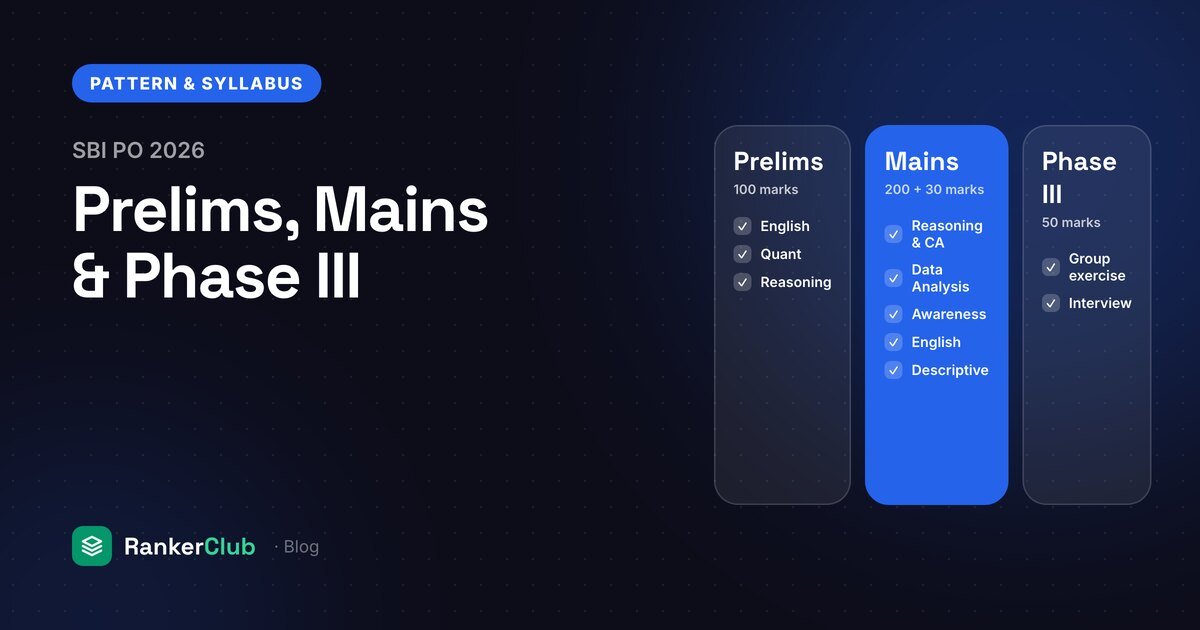
Probationary Officer at the State Bank of India β€” one of the most sought-after banking jobs, with a three-phase selection.

Phase I Prelims: English, Quantitative Aptitude and Reasoning in one hour with sectional timing. Phase II Mains: objective sections on Reasoning, Data Analysis, Economy/Banking Awareness and English, plus a descriptive paper. Phase III: psychometric test, group exercise and interview. Negative marking is 0.25 of the question's marks.

Officer in Grade B (DR) at the Reserve Bank of India β€” a regulator role with a heavy focus on economics and finance.

Phase I: a 200-mark objective paper (General Awareness, English, Quant and Reasoning). Phase II: three papers β€” Economic & Social Issues, English (writing skills) and Finance & Management β€” with objective and descriptive parts. Final stage: interview.

Syllabus

Subjects and important topics

Quantitative Aptitude / Data Interpretation

Simplification & approximationNumber seriesQuadratic equationsPercentage & ratioProfit & lossInterestTime & workSpeed & distanceMixturesData interpretation (tables, bar, pie, line, caselets)Data sufficiency

Reasoning Ability

PuzzlesSeating arrangementSyllogismInequalitiesBlood relationsDirection senseCoding-decodingInput-outputOrder & rankingLogical reasoning (assumptions, arguments)

English Language

Reading comprehensionCloze testError spottingPara jumblesFillersWord swap & usageSentence connectorsDescriptive writing (PO)

Banking & Economy Awareness

RBI and monetary policyBanking terms & instrumentsFinancial inclusion schemesUnion Budget & Economic SurveyCurrent affairs (last 6 months)Static GK (capitals, currencies, headquarters)

Computer Aptitude

Computer fundamentalsMS Office basicsNetworking & internetShortcutsCyber security basics

Strategy

How to prepare for Banking exams

01Train for sectional timing

You cannot borrow time between sections. Practise every section with its own 20-minute timer from day one.

02Puzzles decide Reasoning

Seating arrangements and puzzles carry a large share of Reasoning marks. Solve 3–4 puzzles daily and learn to pick the easiest ones first.

03Read for English and awareness together

Reading one quality newspaper's economy and banking pages builds RC speed and banking awareness at the same time.

04Prepare Mains from the start

Prelims and Mains are only weeks apart. Cover DI, banking awareness and descriptive writing while preparing for Prelims.

05Mock daily in the last month

Bank exams are speed games. One sectional or full mock a day in the final month makes a visible difference.

From the blog

Read next

FAQs

Frequently asked questions about Banking exams

What is the difference between IBPS PO and IBPS Clerk?

PO is an officer-level post with a Mains descriptive paper and an interview; Clerk is a clerical post with no interview and state-wise recruitment that requires the local language.

Is there negative marking in bank exams?

Yes. IBPS and SBI exams deduct 0.25 of the marks assigned to a question for each wrong answer. There is no penalty for unattempted questions.

Are Prelims marks counted in the final selection?

No. Prelims is qualifying only. Final merit for IBPS PO is based on Mains and interview marks (80:20).

Can final-year students apply for bank exams?

Usually you must hold a graduation degree on the date of registration. Final-year students are generally not eligible β€” check the notification for the exact rule.

Which is the easiest bank exam to start with?

Clerk exams (IBPS Clerk, SBI Clerk) have no interview and a slightly easier Mains, so many candidates start there while preparing for PO exams.

Exam patterns, marks and eligibility are based on the latest notifications available and can change from one cycle to the next. Always confirm the details in the official notification on ibps.in before you apply.

Practise for Banking exams

Free full-length mock tests with an instant all-India rank.

Choose your exam β†’