Walk into any bookshop near a coaching hub and you will find dozens of SSC CGL books. You need very few of them. The aspirants who do best usually finish one good book per subject twice, then spend the rest of their time on previous year papers and mocks.
Here is a short, subject-wise list of widely used books, and how to use them.
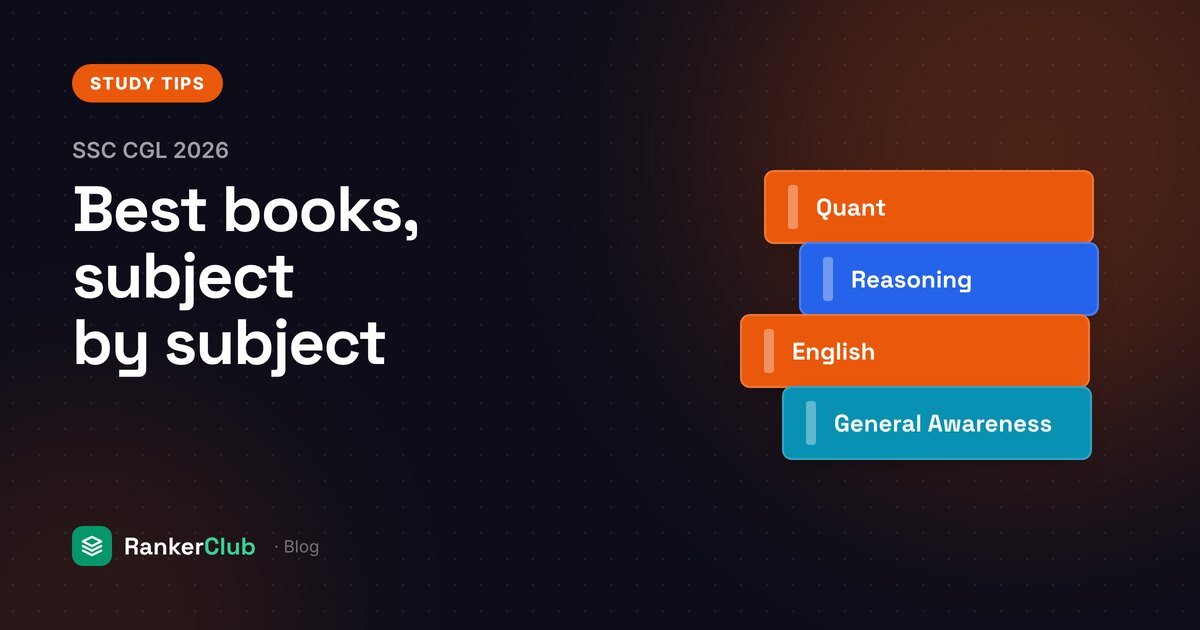
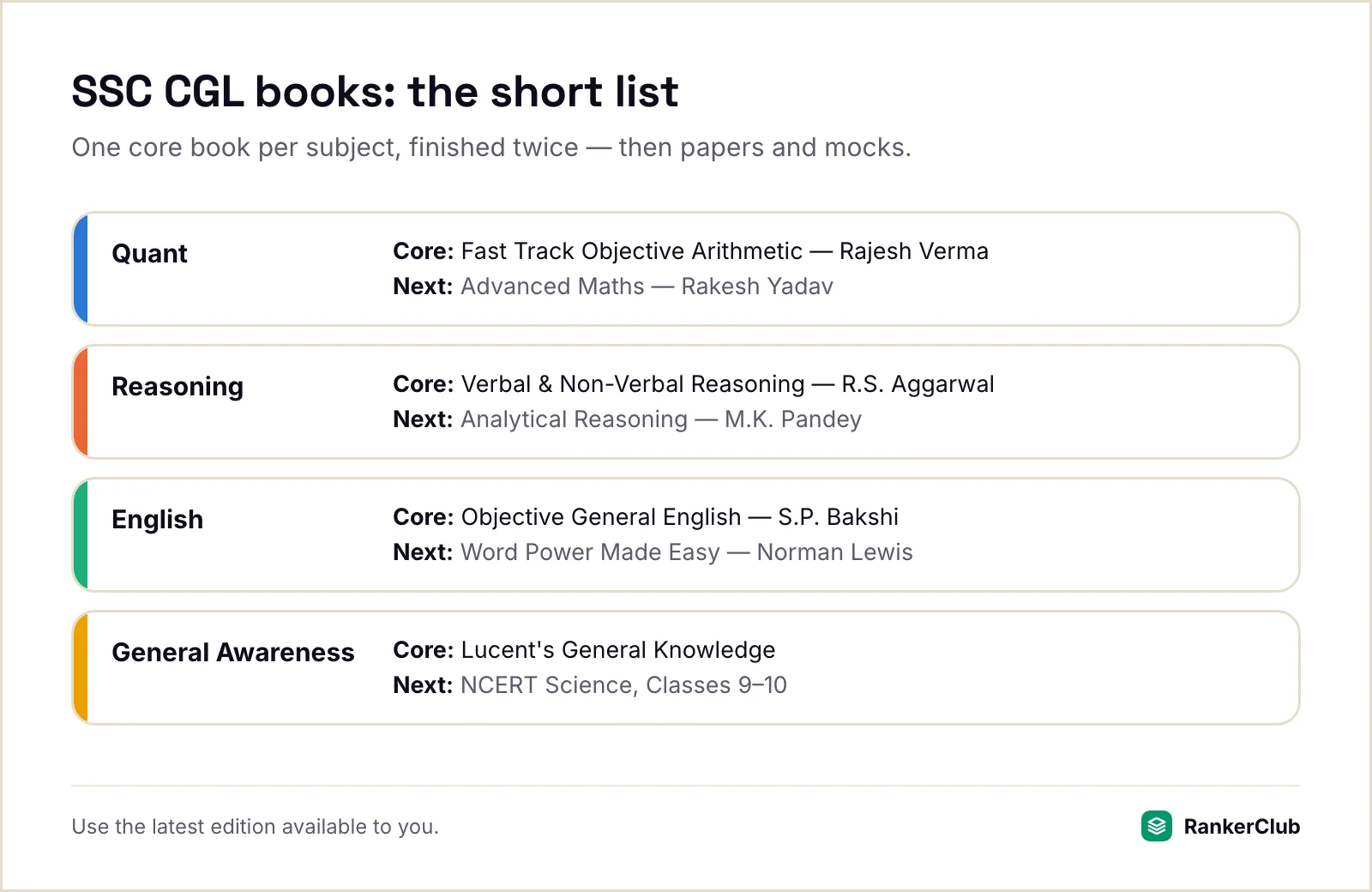
The short list
| Subject | Core book | Practice / advanced |
|---|---|---|
| Quantitative Aptitude | Fast Track Objective Arithmetic — Rajesh Verma (Arihant) | Advanced Maths — Rakesh Yadav |
| Reasoning | A Modern Approach to Verbal & Non-Verbal Reasoning — R.S. Aggarwal | Analytical Reasoning — M.K. Pandey |
| English | Objective General English — S.P. Bakshi | Word Power Made Easy — Norman Lewis |
| General Awareness | Lucent's General Knowledge | NCERT Science (Classes 9–10) |
Book titles and editions change, so pick the latest edition available to you. Any well-reviewed book that covers the syllabus will work — consistency matters more than the exact title.
Quantitative Aptitude
Start with an arithmetic book that explains each chapter from the basics with solved examples, such as Rajesh Verma's Fast Track Objective Arithmetic or R.S. Aggarwal's Quantitative Aptitude for Competitive Examinations. For algebra, geometry and trigonometry — which carry many Tier 1 and Tier 2 questions — use a dedicated advanced maths book. See our SSC CGL maths important topics for what to study first.
Reasoning
R.S. Aggarwal's reasoning book covers both verbal and non-verbal topics with a very large number of practice questions. Once comfortable, add a harder book such as M.K. Pandey's for puzzles and analytical questions useful in Tier 2.
English
S.P. Bakshi's Objective General English is the standard grammar-and-practice book. For vocabulary — a big share of SSC English marks — build your own word list from Word Power Made Easy and from previous year papers. Many aspirants also use Neetu Singh's English books for SSC-style grammar.
General Awareness
Lucent's General Knowledge covers history, polity, geography, economy and science at the right depth. Strengthen science with NCERT books for Classes 9 and 10, and add a monthly current affairs compilation in the last few months. For polity in more depth, M. Laxmikanth's Indian Polity is the standard reference.
Previous year papers
A solved previous year paper book (Kiran's SSC CGL collection is popular) shows you exactly how SSC frames questions. Read our previous year paper analysis and the previous year papers page for official sources.
How to use books with mocks
- Learn a chapter from the core book.
- Practise it with topic-wise questions and answers.
- Test it in a timed SSC CGL mock.
- Return to the book only for the topics your mock shows are weak.
Books build knowledge; mocks build exam performance. You need both.
Frequently asked questions
Which is the best book for SSC CGL maths?
For basics, "Fast Track Objective Arithmetic" by Rajesh Verma or "Quantitative Aptitude for Competitive Examinations" by R.S. Aggarwal. For advanced maths (algebra, geometry, trigonometry), Rakesh Yadav's advanced maths book is widely used.
Is Lucent's General Knowledge enough for SSC CGL GA?
Lucent's covers most static GK and science at the right level. Add NCERT science books for Classes 9–10, a monthly current affairs source and previous year GA questions.
How many books do I need for SSC CGL?
One core book per subject plus a previous year paper collection is enough. Finishing a few books twice beats starting many.
Can I prepare for SSC CGL without books?
You can use online notes and videos for concepts, but a good practice book and plenty of timed mocks are hard to replace. Mocks show you whether your preparation is working.