Previous year papers are the most honest study material you will find. They show what SSC actually asks — not what a book thinks it might ask. Analysing them before you plan your preparation saves weeks of studying topics that barely appear.
This analysis summarises the trends seen across recent SSC CGL Tier 1 papers and shows you how to analyse papers yourself.
Why every shift is different
SSC CGL Tier 1 is held in many shifts over several days, and each shift has its own paper. Scores are then normalised across shifts. That means you will find several "previous year papers" for the same year — one per shift — with slightly different difficulty. Look at several shifts together rather than judging the exam from one paper.
Section-wise trends
General Intelligence & Reasoning
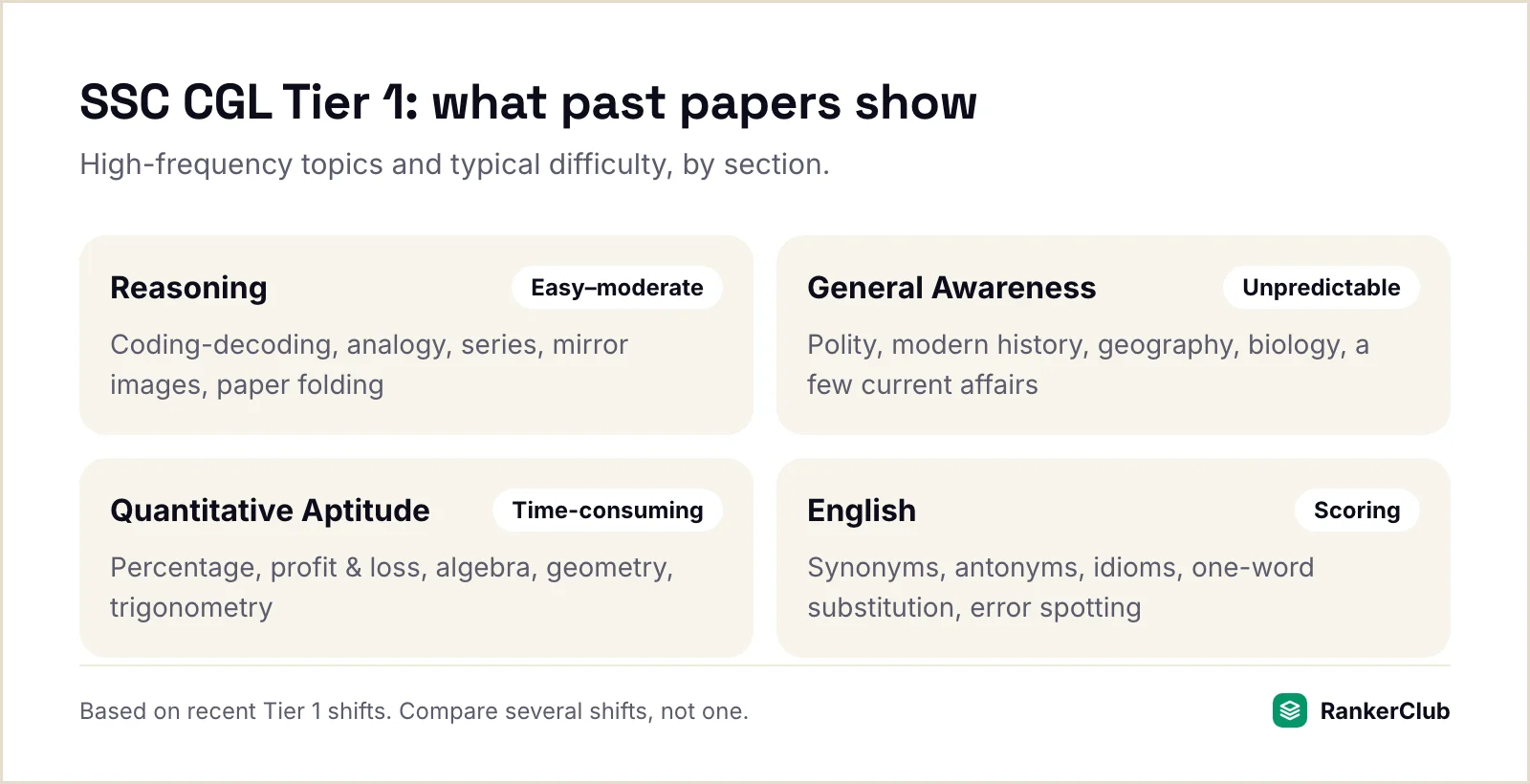
Usually the easiest section to score in. Analogy, classification, series and coding-decoding appear in almost every shift, along with several non-verbal questions (mirror images, paper folding, embedded figures, counting figures). Puzzles are short. A well-prepared candidate can attempt 22 or more of 25.
General Awareness
The least predictable section. Static GK — especially history, polity and geography — and general science make up most of it, with a handful of current affairs questions. Biology and physics questions are often straight from Class 9–10 NCERT books.
Quantitative Aptitude
The most time-consuming section. Advanced maths (algebra, geometry, trigonometry and mensuration) carries roughly as many questions as arithmetic, and there is usually a short data interpretation set. Questions are calculation-heavy rather than conceptually hard.
English Comprehension
Vocabulary dominates: synonyms, antonyms, idioms, one-word substitution and spelling together make up a large share. Error spotting, sentence improvement, voice and narration, and a cloze test or passage make up the rest.
Topics that keep coming back
- Reasoning: coding-decoding, analogy, series, mirror/water image, paper cutting.
- GA: Indian polity (articles, amendments), modern history, physical geography, human biology.
- Quant: percentage, profit and loss, algebraic identities, triangles and circles, trigonometric identities.
- English: synonyms and antonyms, idioms, one-word substitution, error spotting.
Practise each of these with answers on our SSC CGL topic-wise practice page.
How to analyse a previous year paper yourself
- Solve it in exactly 60 minutes with negative marking. No pausing.
- Tag every question by topic. Count how many questions each topic had.
- Mark each wrong or skipped question as concept gap, calculation error, time trap or lucky guess.
- Compare across three to five shifts. Topics that show up in every shift go to the top of your study list.
The same method works for mock tests — see how to analyse a mock test.
Where to find the papers
SSC uploads each shift's question paper and answer key on ssc.gov.in after the exam, usually only for a limited period, so download them while they are available. Our previous year papers page lists official sources for SSC CGL, CHSL, MTS, RRB NTPC and IBPS PO, and free SSC CGL mocks in the same pattern with full solutions.
Frequently asked questions
Do SSC CGL questions repeat from previous years?
Exact questions rarely repeat, but the same topics and question types appear every year — especially in vocabulary, static GK and arithmetic. That is why previous papers are so useful for planning.
Where can I find SSC CGL previous year papers?
SSC publishes the question papers with answer keys for each shift on ssc.gov.in after the exam, usually for a limited time. Our previous year papers page lists the official sources and free mocks in the same pattern.
How many previous year papers should I solve?
Solve at least five to ten recent Tier 1 shifts under timed conditions. Analysing them properly matters more than the number you solve.
Which section is the hardest in SSC CGL Tier 1?
For most candidates Quantitative Aptitude is the most time-consuming, while General Awareness is the most unpredictable. Reasoning and English are usually the best scoring sections.