If you are starting SSC CGL preparation from zero, the hardest part is not the syllabus — it is knowing where to begin. Most beginners either jump straight into difficult questions and lose confidence, or spend months reading theory without ever testing themselves.
This beginner strategy gives you a clear order to follow. If you already know the basics and want a fixed timeline, our 6-month SSC CGL plan is the next step.
Step 1: Understand what the exam asks
Before opening a single book, spend one day on the exam itself:
- Read the complete SSC CGL syllabus and note the four Tier 1 subjects.
- Take one free SSC CGL mock test without any preparation. Your score does not matter — you are learning what the questions look like and how fast 60 minutes goes.
- Note which section felt hardest. That is where your daily time should be highest.
The 4-phase beginner plan
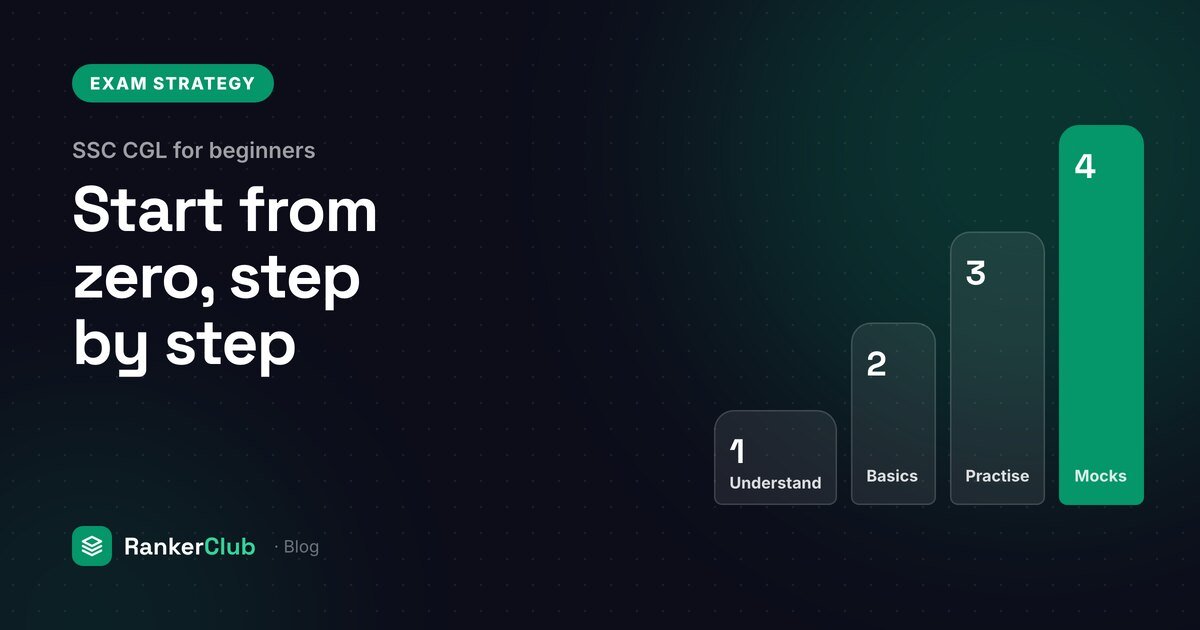
Think of your preparation in four phases. Each one has a single goal, so you always know what "done" looks like.
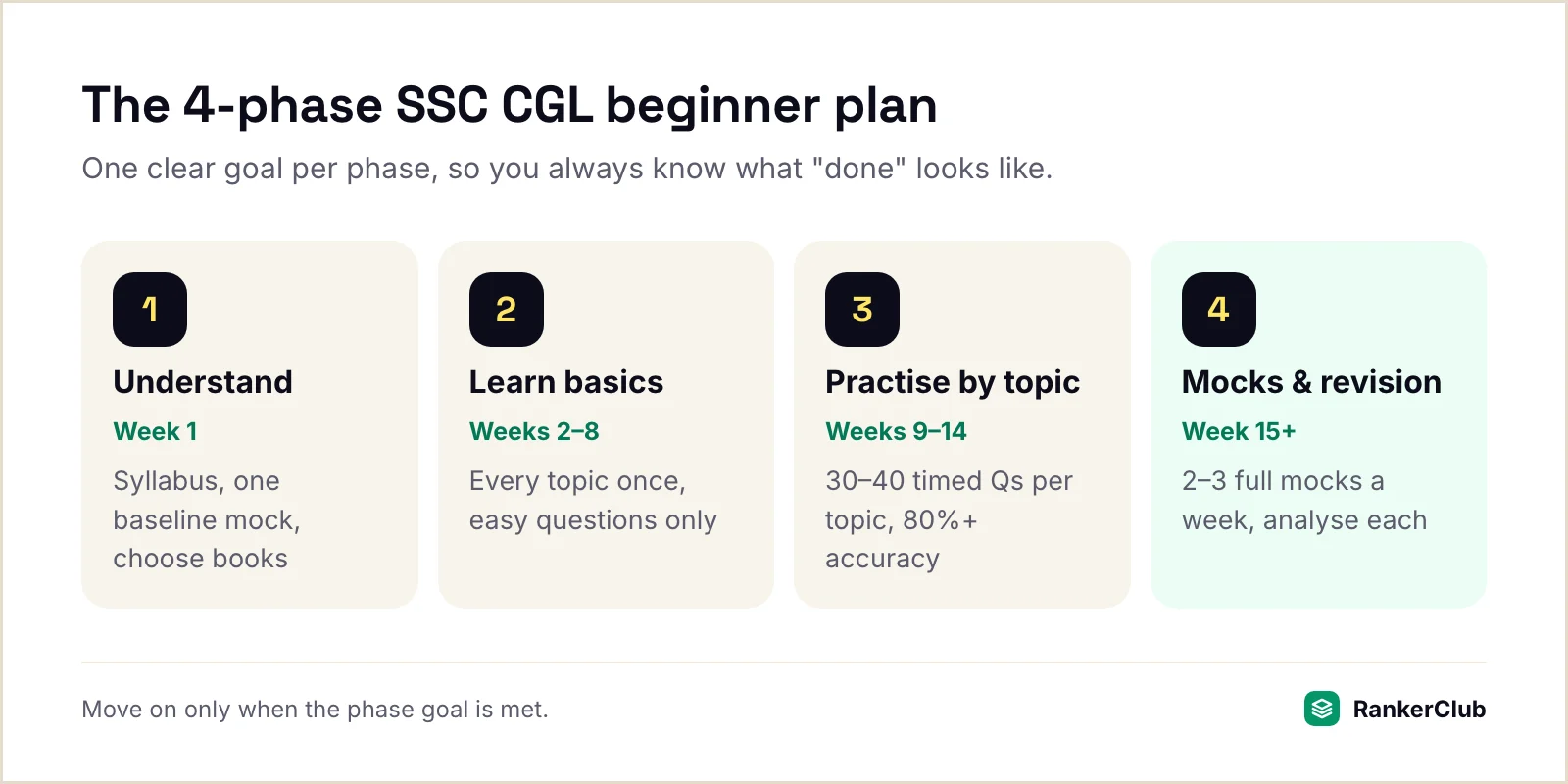
- Phase 1 — Understand (week 1): syllabus, one baseline mock, collect your books.
- Phase 2 — Learn the basics (weeks 2–8): cover the basic concepts of every topic once. Easy questions only.
- Phase 3 — Practise by topic (weeks 9–14): 30–40 questions per topic, timed, until your accuracy is above 80%.
- Phase 4 — Mocks and revision (week 15 onwards): two to three full mocks a week, with proper analysis after each one.
What to study first in each subject
Quantitative Aptitude
Begin with the foundations everything else depends on: tables up to 30, squares up to 30, cubes up to 20, then number system and simplification. Move to percentage, ratio and average, because profit and loss, interest and time-and-work all build on them. Leave geometry and trigonometry until the arithmetic feels comfortable.
English
Start a vocabulary notebook on day one — 15 new words a day, revised every weekend. Learn grammar rules in this order: parts of speech, tenses, subject-verb agreement, articles and prepositions. Read one editorial a day to build comprehension speed.
Reasoning
Reasoning is the quickest subject to improve. Begin with analogy, classification, series and coding-decoding, then add blood relations, direction sense and the non-verbal topics.
General Awareness
Do not try to "finish" GA. Make it a 30-minute daily habit: 15 minutes of static GK (polity, history, science) and 15 minutes of current affairs.
A daily routine for beginners
- Morning (2 hours): Quant — learn one concept, then solve 25 questions on it.
- Afternoon (1.5 hours): English — grammar rule plus vocabulary.
- Evening (1 hour): Reasoning — one topic, 30 questions.
- Night (30 minutes): GA and revision of the day's mistakes.
Use topic-wise practice questions for phase 3 so you can check every answer and explanation immediately.
Five beginner mistakes to avoid
- Collecting too many books. One book per subject, finished twice, beats five books started.
- Avoiding mocks until you "feel ready". You will never feel ready. Mocks are how you get ready.
- Taking mocks without analysing them. Spend as long reviewing a mock as you spent writing it — see how to analyse a mock test.
- Ignoring English. English carries a large share of Tier 2 marks; it cannot be left for the end.
- Changing strategy every week. Give any plan at least a month before judging it.
How to know you are on track
By the end of phase 3 you should be scoring at least 15 out of 25 in each Tier 1 section in timed practice. If one section is far behind, give it an extra daily hour for two weeks before moving to full mocks.
Frequently asked questions
How many hours a day should a beginner study for SSC CGL?
Five to six focused hours a day is enough for a full-time aspirant. If you are working or in college, three hours on weekdays and six to eight hours at weekends works, but plan for a longer timeline.
Can I crack SSC CGL without coaching?
Yes. Many selected candidates prepare on their own using standard books, previous year papers and online mock tests. What matters is a fixed routine and regular mock analysis, not where you learn.
Which subject should a beginner start with?
Start with Quantitative Aptitude and English together, because both take the longest to build. Add Reasoning after two weeks and General Awareness as a daily 30-minute habit.
When should a beginner start taking mock tests?
Take one full mock in the first week just to understand the exam, then start regular mocks once you have covered the basics of every section — usually after about two months.