The SSC CGL syllabus looks huge on paper — four subjects in Tier 1, six components in Tier 2 and two extra papers for specialist posts. In practice it is very predictable: the same topics appear every year, and once you know where the marks come from, you can plan your preparation around them.
This guide lists the complete SSC CGL syllabus for 2026, tier by tier and subject by subject, along with the exam pattern and the topics that deserve most of your time.
SSC CGL 2026 at a glance
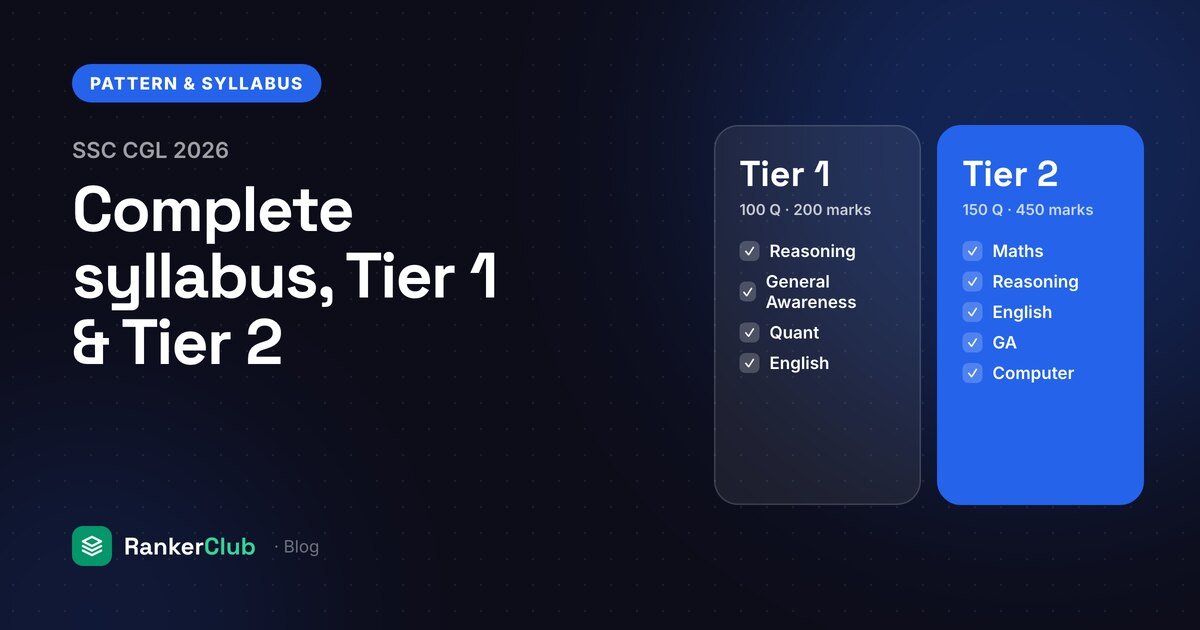
SSC CGL is held in two computer-based tiers. Tier 1 is a qualifying screening test; Tier 2 decides your rank and the post you get.

| Tier 1 | Tier 2 (Paper I) | |
|---|---|---|
| Questions | 100 | 150 scored + computer module |
| Marks | 200 | 450 |
| Time | 60 minutes | 2 hours 30 minutes (Session I) |
| Negative marking | 0.50 per wrong answer | 1 mark per wrong answer |
| Counts for final merit? | No (qualifying) | Yes |
Exact timings and marks are confirmed in each year's notification, so check the official SSC CGL 2026 notice on ssc.gov.in before your exam.
Tier 1 syllabus
Tier 1 has four sections of 25 questions each, 2 marks per question. For a section-by-section breakdown of the pattern, see our SSC CGL Tier 1 exam pattern guide.
General Intelligence & Reasoning
- Verbal reasoning: analogy, classification (odd one out), series, coding-decoding, blood relations, direction sense, order and ranking, syllogism, alphabet and word order, mathematical operations, calendar and clocks.
- Non-verbal reasoning: mirror and water images, paper folding and cutting, embedded figures, figure series, counting triangles and squares, dice.
General Awareness
- Static GK: history, geography, Indian polity, economy, art and culture.
- General science: physics, chemistry and biology at Class 10 level.
- Current affairs: the last 6–8 months — appointments, awards, sports, schemes, summits, books and authors.
Quantitative Aptitude
- Arithmetic: number system, simplification, percentage, ratio and proportion, average, profit, loss and discount, simple and compound interest, time and work, time, speed and distance, mixture and alligation, partnership.
- Advanced maths: algebra, geometry (triangles, circles, polygons), mensuration (2D and 3D), trigonometry including heights and distances.
- Data interpretation: bar graphs, pie charts, tables and line graphs.
English Comprehension
- Vocabulary: synonyms, antonyms, idioms and phrases, one-word substitution, spelling correction.
- Grammar: error spotting, sentence improvement, fill in the blanks, active and passive voice, direct and indirect speech.
- Comprehension: reading passages and cloze tests.
Tier 2 syllabus
Tier 2 Paper I is compulsory for every post. It is split into sections that are taken in one sitting, plus a typing test.
- Mathematical Abilities (30 questions): everything in Tier 1 Quant at a deeper level, plus statistics basics (mean, median, mode) and probability.
- Reasoning and General Intelligence (30 questions): the Tier 1 topics with harder puzzles and more non-verbal questions.
- English Language and Comprehension (45 questions): the biggest single section — longer passages, cloze tests, sentence rearrangement and grammar.
- General Awareness (25 questions): static GK, science and current affairs.
- Computer Knowledge (20 questions, qualifying): computer basics, MS Office, internet and email, networking and cyber security.
- Data Entry Speed Test (qualifying): typing a passage in 15 minutes.
Paper II and Paper III
Paper II (Statistics) is only for Junior Statistical Officer and Statistical Investigator posts. Paper III (General Studies — Finance and Economics) is only for Assistant Audit Officer and Assistant Accounts Officer posts. Skip them unless you are applying for those posts.
Which topics to prioritise
Every topic can appear, but they don't all carry equal weight. Spend your first months on the topics that appear in almost every shift:
- Quant: percentage, profit and loss, ratio, algebra, geometry and trigonometry. Practise them with our SSC CGL topic-wise questions.
- English: vocabulary (synonyms, antonyms, idioms, one-word substitution) and error spotting — quick marks if your word list is strong.
- Reasoning: coding-decoding, analogy, series and the non-verbal topics.
- GA: polity, history and science, then current affairs in the final three months.
How to use this syllabus
Print the topic list and tick topics off as you finish them. Once a section is covered, take a timed SSC CGL mock test to see whether you can actually score in it under pressure — that is the only real test of whether a topic is "done".
Frequently asked questions
Has the SSC CGL syllabus changed for 2026?
The subjects have stayed the same since the 2022 revision: Reasoning, General Awareness, Quantitative Aptitude and English in Tier 1, and Mathematical Abilities, Reasoning, English, General Awareness, Computer Knowledge and a typing test in Tier 2. Always confirm small changes in the official SSC CGL 2026 notification on ssc.gov.in.
Is Tier 1 counted in the final SSC CGL merit?
No. Tier 1 is a qualifying screening test. The final merit list is prepared from Tier 2 marks (Paper I, plus Paper II or III for the posts that need them).
Which is the hardest part of the SSC CGL syllabus?
For most aspirants it is Advanced Maths (algebra, geometry and trigonometry) and the English section of Tier 2, which has 45 questions. These need the longest preparation time.
Do I need to study Statistics for SSC CGL?
Only if you are applying for Junior Statistical Officer (JSO) or Statistical Investigator posts, which have Paper II (Statistics). Other posts do not need it.