"Never guess in a negative-marking exam" is one of the most repeated pieces of advice in exam prep. It is also wrong — or at least, badly incomplete. Let's do the maths.
The expected-value idea
Every guess has an expected value: the marks you'd gain on average if you made that same guess many times.
Expected value = (chance of right × marks for right) − (chance of wrong × penalty)
If the expected value is positive, guessing helps you on average. If it is negative, skipping is better.
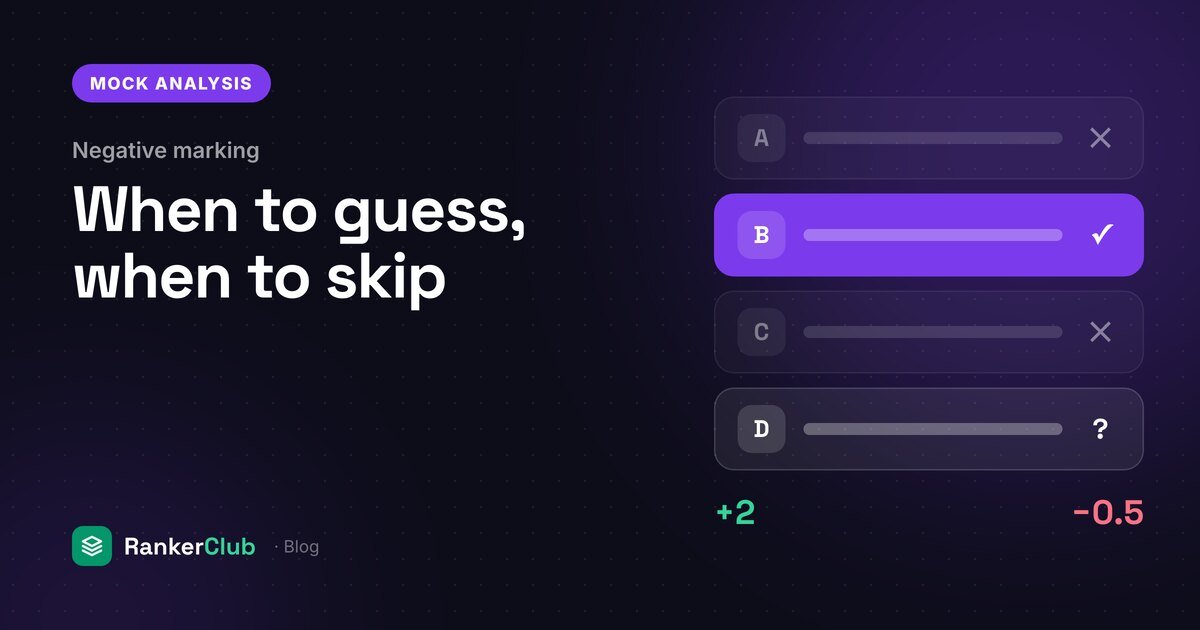
Example: SSC CGL (+2 / −0.5, four options)
A completely blind guess
Chance of being right = 1/4.
EV = (1/4 × 2) − (3/4 × 0.5) = 0.5 − 0.375 = +0.125 marks
Even a blind guess is slightly positive here. But it's a tiny edge with a lot of variance.
After eliminating one option
Chance of being right = 1/3.
EV = (1/3 × 2) − (2/3 × 0.5) = 0.667 − 0.333 = +0.33 marks
After eliminating two options
Chance of being right = 1/2.

EV = (1/2 × 2) − (1/2 × 0.5) = 1 − 0.25 = +0.75 marks
Every option you eliminate makes guessing dramatically more valuable. The skill to build is not "guessing" — it is elimination.
Example: IBPS / RRB (−1/4 or −1/3 of question marks, five options)
With five options and a 1/4 penalty on a 1-mark question, a blind guess gives (1/5 × 1) − (4/5 × 0.25) = 0.2 − 0.2 = 0. No edge at all. Eliminate one option and it becomes positive again.
So what should you actually do?
- Never blind-guess in a five-option exam — the expected gain is zero and the variance hurts.
- Do guess when you can confidently eliminate at least one option, and especially two.
- Don't spend time to make a guess. If eliminating options takes 90 seconds, that time is better spent on a question you can fully solve.
- Watch your section accuracy. If your accuracy is below 70%, your "confident" eliminations aren't as confident as you think. Fix concepts first.
The hidden cost: confidence
The maths ignores one thing — psychology. A string of wrong guesses early in a paper can rattle you for the rest of the exam. Practise your guessing rules in mocks, check whether they actually add marks, and only then trust them on exam day.
Your mock results on RankerClub show exactly how many marks you lost to negatives in each section — use them to calibrate your own guessing threshold. Take a free mock to find yours.
Frequently asked questions
Should I guess in an exam with negative marking?
Guess only when you can eliminate at least one option. With SSC-style marking (+2/−0.5), eliminating two options gives an expected +0.75 marks per guess. Blind guessing in five-option exams has zero expected gain.
How do I calculate expected marks for a guess?
Multiply the chance of being right by the marks for a correct answer, then subtract the chance of being wrong multiplied by the penalty.
How can I reduce negative marks?
Improve elimination skills, keep a silly-mistakes notebook, and skip questions that would take too long. Track marks lost to negatives in every mock.