SSC MTS (Multi-Tasking Staff) is the SSC exam for Class 10 pass candidates. The same exam is used to select Havaldars for the Central Board of Indirect Taxes and Customs (CBIC) and the Central Bureau of Narcotics (CBN).
Below is the complete SSC MTS syllabus for 2026, the session-wise exam pattern, the Havaldar physical tests and the topics that give the quickest marks.
SSC MTS 2026 at a glance
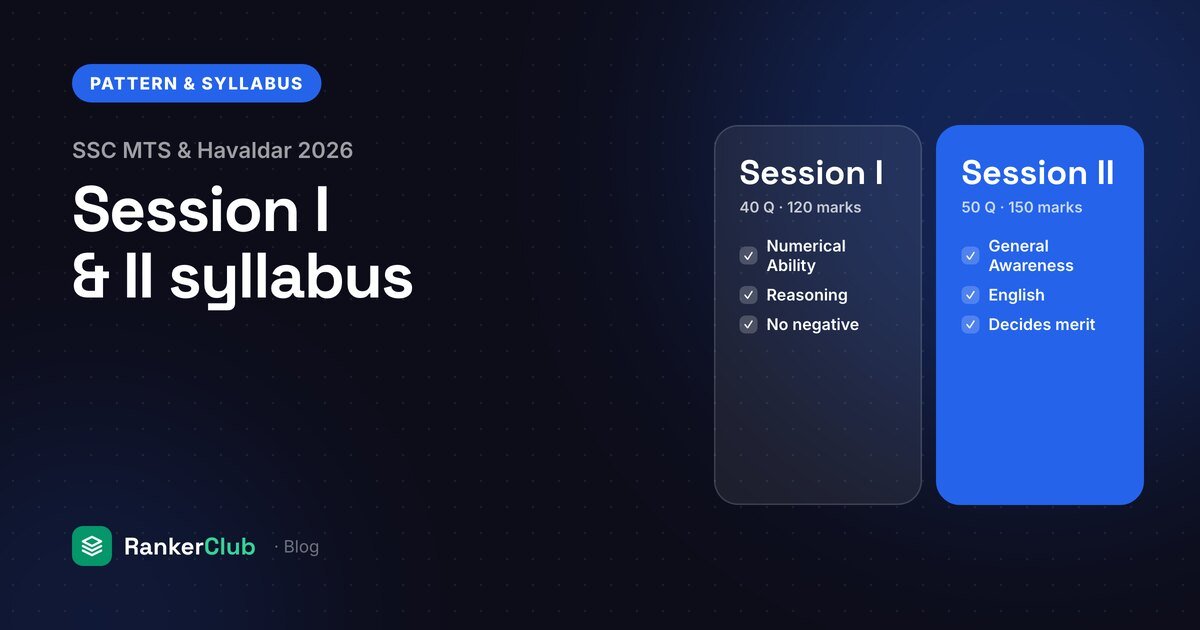
The computer-based exam has two sessions, held one after the other on the same day. Both are compulsory.
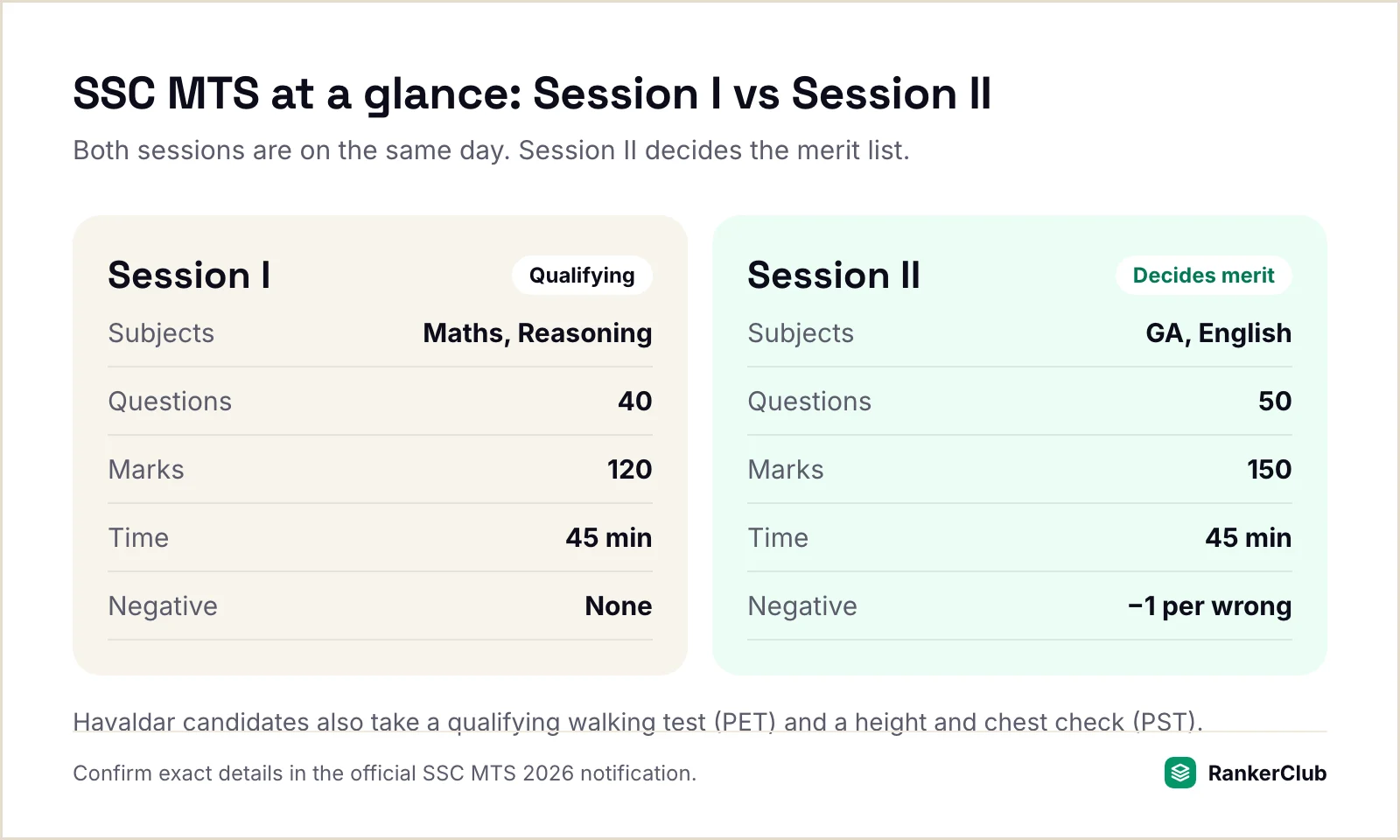
| Session I | Session II | |
|---|---|---|
| Subjects | Numerical Ability, Reasoning | General Awareness, English |
| Questions | 40 | 50 |
| Marks | 120 | 150 |
| Time | 45 minutes | 45 minutes |
| Negative marking | None | 1 mark per wrong answer |
| Role | Qualifying | Decides merit |
In total that is 90 questions and 270 marks, with 3 marks per question. Check the official SSC MTS 2026 notification on ssc.gov.in for any change before your exam.
Session I exam pattern
- Numerical and Mathematical Ability: 20 questions, 60 marks
- Reasoning Ability and Problem Solving: 20 questions, 60 marks
There is no negative marking in Session I, so attempt every question. You must clear the qualifying marks in Session I before Session II is evaluated.
Session II exam pattern
- General Awareness: 25 questions, 75 marks
- English Language and Comprehension: 25 questions, 75 marks
Session II has negative marking of 1 mark per wrong answer, and these marks decide the merit list. This is where most candidates win or lose their seat.
SSC MTS syllabus, subject by subject
Numerical and Mathematical Ability
- Integers and whole numbers, LCM and HCF, decimals and fractions
- Percentage, ratio and proportion, average
- Profit and loss, discount, simple interest
- Time and work, time, speed and distance
- Basic mensuration (area and perimeter), basic geometry
- Reading tables and graphs
Reasoning Ability and Problem Solving
- Alphanumeric series, analogy, classification (odd one out)
- Coding-decoding, blood relations, direction sense
- Order and ranking, venn diagrams, missing numbers
- Mirror images, paper folding, embedded and counting figures
General Awareness
- Static GK: Indian history, geography, polity, economy, culture
- General science: Class 10 level physics, chemistry and biology
- Current affairs: national and international news, sports, awards, government schemes
English Language and Comprehension
- Spot the error, fill in the blanks, sentence improvement
- Synonyms, antonyms, one-word substitution, idioms and phrases, spelling
- Sentence rearrangement, cloze test, reading comprehension
You can practise every one of these topics separately with our SSC MTS topic-wise practice.
Havaldar physical tests (PET and PST)
Candidates selected for Havaldar posts must also qualify a Physical Efficiency Test and a Physical Standard Test. These are qualifying only.
- PET (walking): men walk 1,600 metres in 15 minutes; women walk 1 km in 20 minutes.
- PST: minimum height of 157.5 cm for men and 152 cm for women, and a chest of 76 cm (81 cm expanded) for men. Relaxations apply for some categories and regions.
Physical standards are taken from the notification and can be revised, so confirm them in the official SSC MTS 2026 notice.
Topics to study first
- English and General Awareness first. They make up all of Session II, which decides your merit, and they carry negative marking.
- Arithmetic basics: percentage, ratio, average and simple interest cover a large share of the maths questions.
- Quick reasoning: series, analogy and coding-decoding take seconds once practised.
- Full mocks: after one round of the syllabus, take an SSC MTS mock test every week to practise both sessions together.
For a way to turn every mock into higher marks, read how to improve your mock test score.
Frequently asked questions
Is there negative marking in SSC MTS?
There is no negative marking in Session I (Numerical Ability and Reasoning). In Session II (General Awareness and English), 1 mark is deducted for each wrong answer.
Are both SSC MTS sessions compulsory?
Yes. Both sessions are held on the same day and you must attempt both. Session II is evaluated only if you qualify in Session I.
What is the difference between MTS and Havaldar selection?
Both take the same computer-based exam. Havaldar candidates must also pass a Physical Efficiency Test (walking) and a Physical Standard Test (height and chest). MTS has no physical test.
What is the qualification for SSC MTS?
You need to have passed Class 10 (matriculation) from a recognised board. The age limit is usually 18 to 25 years for MTS and 18 to 27 years for Havaldar, with relaxation for reserved categories.
Is the SSC MTS exam easy?
The questions are at Class 10 level, but competition is very high, so the cut-off is decided by accuracy in Session II. Strong General Awareness and English usually make the difference.